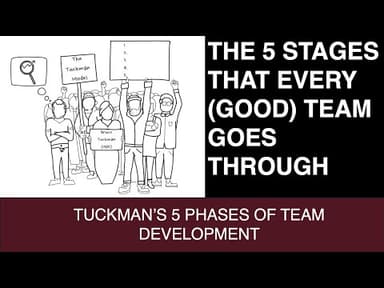
Tuckman's 5 Stages of Team Development (Forming, Storming, Norming, Performing, Re-forming)
The Right Questions
AI summary of “Tuckman's 5 Stages of Team Development (Forming, Storming, Norming, Performing, Re-forming)” by The Right Questions, generated by Sumvid.
Title
The Tuckman Model: Five Stages of Team Development
One-Sentence Summary
The Tuckman model identifies five predictable stages—forming, storming, norming, performing, and adjourning—that teams must progress through to become effective, and managers can facilitate this development by understanding and addressing each stage's unique challenges.
Key Takeaways
- [0:00] The Tuckman model, developed by Bruce Tuckman, demonstrates that teams evolve through five distinct stages: forming, storming, norming, performing, and adjourning, and while managers can accelerate progress, the process cannot be completely bypassed.
- [0:31] The forming stage involves team members coming together and addressing fundamental questions ("Why am I here?" and "Who are you?"), requiring leaders to cast a clear vision, define success, and facilitate relationship-building among members.
- [1:32] During the storming phase, conflicts over roles, goals, and work approaches emerge as people become more assertive; managers must clearly communicate the mission and facilitate agreement on ways of working to help the team move forward.
- [2:36] In the norming stage, the team stabilizes and members find their place; leaders should identify barriers to performance and make adjustments to roles, tasks, and processes while providing encouragement and support.
- [3:06] The performing stage represents peak team effectiveness with exponential outputs; leaders must cultivate psychological safety and personal development while continuously asking teams what to stop, continue, and start doing to prevent complacency.
- [4:08] The adjourning phase occurs when projects end or team members leave, requiring leaders to help the team acknowledge this transition, celebrate accomplishments, and support individuals through grief or disappointment.
- [5:10] Understanding the Tuckman model benefits both managers and team members, as shared awareness of team progression helps normalize difficult phases like storming and enables teams to self-propel through the cycle more quickly.
Suggested Category Tags
Leadership, Team Development, Management Training, Organizational Behavior, Business Strategy
Want a summary like this for your own video?
Summarize your own video — free