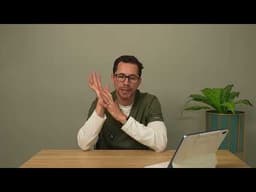
Factors That Help or Hinder Learning: Neuromyths, Sleep, and Emotional Regulation
AI summary of “Factors That Help or Hinder Learning: Neuromyths, Sleep, and Emotional Regulation” by Centro de Conocimiento Alejandría, generated by Sumvid.
Title
Factors That Help or Hinder Learning: Neuromyths, Sleep, and Emotional Regulation
One-Sentence Summary
A psychology lecture that reviews what affects learning (attention, retrieval, spacing, sleep, and emotion), debunks popular learning myths, and teaches a short grounding exercise and a framework for responding to strong emotions.
Worth Watching If
You are a student, educator, or anyone interested in study habits and basic cognitive psychology and want a clear overview of why cramming and late-night study fail and which popular learning claims lack evidence. Much of it is a classroom recap and repeats basics, and the case examples are anecdotal, so the value is mostly in the myth-busting and the emotion-regulation framing.
Chapters
- [0:04] Recap of factors that help learning: attention, retrieval, spacing, sleep, physical activity, and emotion/meaning
- [2:11] Reframing tasks around their larger purpose to raise motivation and interest
- [2:43] Case of "Daniel," who studied with his phone nearby, in poor light, and without sleep, then blanked on the exam; the lecturer breaks down why
- [7:56] Introduction to neuromyths and the value of critical thinking about popular psychology
- [10:03] Myth 1: we use only 10% of our brains
- [11:05] Myth 2: students learn better when taught according to their learning style
- [12:07] Myths about passive learning (sleep recordings) and the "Mozart effect"
- [13:10] Myth 4: memory works like a recording
- [18:28] Self-check questions for attention, encoding, retrieval, spacing, and sleep
- [22:45] Why studying for hours can still produce poor recall
- [25:27] Guided grounding exercise: breathing and noticing sensory stimuli
- [33:03] Emotions, the body, and emotional regulation, including a mountain-fall example and a stage-fright example
Key Takeaways
- [10:03] The "we use only 10% of our brain" claim is false; different brain circuits activate depending on the task, and the lecturer notes this myth fuels self-help products that promise to "unlock" the rest.
- [11:05] Matching teaching to a supposed learning style ("visual," "auditory," "kinesthetic") has no solid evidence behind it, and the lecturer cites Frank Coffield's argument that students benefit more from a flexible repertoire of strategies than from a fixed style label.
- [12:07] Learning cannot happen automatically through passive methods such as listening to a recording during sleep, and the "Mozart effect" claim that music boosts infant intelligence is presented as debunked.
- [13:10] Memory is reconstructive rather than a recording, so it can be shaped by controllable and uncontrollable factors.
- [2:43] Daniel's failure is attributed to learning conditions, not lack of intelligence: phone distraction, poor lighting, sleep deprivation, and then anxiety that consumed attention during the exam.
- [5:17] Studying at night works against the body's biology; sleep deprivation reduces the cognitive resources available for encoding and consolidation.
- [22:45] Hours of study do not guarantee retention because learning depends on attention, processing, retrieval, consolidation, sleep, and rest, not just time spent.
- [36:55] An emotional experience is both a thought and a bodily reaction involving interacting physiological systems, which is why anxiety shows up as racing heart, tight chest, or trembling.
- [43:43] Emotions are not inherently dangerous; what matters is how a person reacts to them, and the lecturer frames every response as a choice between acting in line with the emotion or in line with one's values and purposes.
- [46:22] For someone with stage fright, the options range from presenting anyway to hiding or refusing, and the lecturer argues the most valuable skill is recognizing that a second option (acting on values) always exists.
Action Items
- Before studying, identify what competes for your attention (phone notifications, people, noise) and remove or silence it.
- Study in distributed sessions with breaks instead of one long cram session.
- Test yourself by recalling material from memory without looking at notes, then check what you missed.
- Protect sleep, especially before exams, rather than trading it for extra study hours.
- When you feel strong anxiety, try the grounding exercise: slow breathing, then noticing three sounds, three sights, three touch sensations, and three smells.
- When facing a feared situation, pause and ask whether your next action serves your values or only the urge to escape.
- Be skeptical of learning products that promise effortless results, such as sleep-learning tapes or "learning style" tests used to dictate teaching.
Caveats
- The lecture relies on anecdotal client and classroom examples (such as a patient who felt a ping-pong ball in her throat) that cannot be verified and are not evidence for the broader claims.
- Sources are referenced loosely; the speaker attributes the myth-busting to Scott Lilienfeld's book on popular psychology myths but does not provide details, and several quotes (such as Coffield's and the "Henry 2007" reference) are garbled in the transcript and cannot be confirmed as stated.
- The speaker's remark that Lilienfeld "abandoned us" appears to be a misstatement or transcription error and should not be taken as a factual claim about the author.
- The bear-freezing analogy is a loose metaphor, not a precise account of fear responses.
- The lecture makes a strong claim that "the best teaching strategy" prepares students for changing real-world challenges without citing supporting research.
Suggested Category Tags
More from Centro de Conocimiento Alejandría
Emotion Regulation, Impulses, and the Brain-Body Link: A Final Session on Behavioral Neuroscience
Centro de Conocimiento Alejandría
Attention, Memory, and Learning: Neuroscience Basics for Students (Spanish-language lecture)
Centro de Conocimiento Alejandría
Experiential Avoidance, Thoughts, and the Nervous System: A Clinical Psychology Lecture on Emotional Regulation
Centro de Conocimiento Alejandría