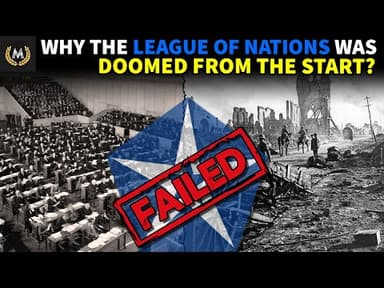
AI summary of “What Was The League Of Nations And Why Did It Fail?” by Mastering Knowledge, generated by Sumvid.
Title
The Rise and Fall of the League of Nations: Lessons from History's Failed Peace Organization
One-Sentence Summary
The League of Nations, established after World War I to prevent future global conflicts, ultimately failed due to the absence of major powers like the United States and the inability to stop aggressive expansionism by fascist regimes, leading to its dissolution in 1945 and replacement by the United Nations.
Key Takeaways
- [0:00] The League of Nations was officially established in January 1920 with 58 member countries at its peak in 1935, but disbanded in 1945 after failing to prevent World War II.
- [1:02] American President Woodrow Wilson championed the League's formation at the 1919 Paris Peace Conference, but the United States ultimately declined to join due to isolationist opposition and concerns about financial contributions and sovereignty.
- [3:06] The League established key principles including shared responsibility among members, collective defense mechanisms, and a commitment to settle disputes through discussion rather than military force, with economic sanctions as a first resort.
- [4:08] The League's credibility was immediately questioned when it failed to intervene in the Russian invasion of Persia and subsequently failed to stop Italian occupation of Corfu, establishing a pattern of ineffectiveness throughout the 1920s and 1930s.
- [5:41] Despite military failures, the League achieved notable humanitarian successes, including repatriating over 500,000 prisoners of war, creating the Nansen passport for refugees, freeing 200,000+ enslaved people, and combating diseases like malaria and leprosy.
- [6:11] The League proved powerless to stop aggressive expansionism by Japan (invading Manchuria in 1932), Germany, and Italy (invading Ethiopia in 1935), as these nations simply ignored League condemnation and withdrew from the organization.
- [8:14] The League of Nations' fundamental shortcomings—the absence of the United States and withdrawal of major powers—left it unable to enforce its mandate, but it provided the structural foundation upon which the more cohesive United Nations was successfully built in 1945.
Suggested Category Tags
History, International Relations, World War II, United Nations, Political Science
Want a summary like this for your own video?
Summarize your own video — free