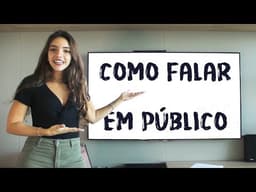
Public Speaking Tips: Slides, Delivery, and Overcoming Stage Fright
AI summary of “Public Speaking Tips: Slides, Delivery, and Overcoming Stage Fright” by Débora Aladim, generated by Sumvid.
Title
Public Speaking Tips: Slides, Delivery, and Overcoming Stage Fright
One-Sentence Summary
A history teacher shares practical advice on designing engaging presentations, delivering them with confidence, and dealing with nervousness, whether for school, university, or work.
Worth Watching If
You have an upcoming presentation, class, or talk and want quick, actionable tips on slides and delivery, especially if you feel nervous. It is mostly general advice based on the speaker's personal experience rather than research, so experienced presenters will find little new.
Chapters
- [0:06] Introduction: the speaker explains that the video collects tips for engaging presentations and for overcoming fear of public speaking.
- [1:07] Know your audience, then tailor language, tone, and slide style to them.
- [2:19] Make slides visually appealing with images and GIFs, and keep text sparse.
- [3:53] Involve the audience with questions at the start or end, using a painting or a historical example as an illustration.
- [4:31] Use relatable examples and personal stories, and re-engage a drifting audience with a joke or image.
- [6:11] Avoid reading slides; if you must read, look up during pauses and signal that you're quoting an author.
- [8:33] Use cue cards or a clipboard instead of loose sheets, and paraphrase slide content.
- [10:12] Bring physical objects, use large images, big numbers, and charts to create impact.
- [12:33] Body language and delivery: speak to the audience, project your voice, gesture naturally, and appear calm even when you're not sure.
- [16:27] Overcoming nervousness: rehearse aloud, test the talk on a layperson, and remember that most audiences forget presentations quickly.
- [19:23] Practical tricks: look at a person's nose or forehead instead of their eyes, and arrange for a friend to ask a planned question.
- [22:38] Closing: make it clear the presentation has ended, invite questions, and thank the audience.
Key Takeaways
- [1:07] Always tailor the presentation to the audience's patience, language level, and interests, since a formal audience may need a very different style.
- [2:19] Use visually attractive slides with images and GIFs, and avoid plain black-and-white text slides, which the speaker calls tedious.
- [2:50] Limit slides to keywords (e.g., "jacobinos" for a lesson on the French Revolution) and elaborate verbally, which signals mastery.
- [6:11] Avoid reading slides; if reading is unavoidable, look up at the audience during pauses, and say explicitly when you are quoting an author (e.g., Georges Duby).
- [8:33] Replace loose paper with a small card or clipboard, which the speaker says looks more professional.
- [10:12] Bring real objects (a coin, an artifact, a model) to make content more memorable.
- [11:20] Large images and big numbers create impact; the speaker suggests showing a big painting and asking the audience what they see.
- [16:27] Rehearse aloud, record yourself, and test the talk on someone unfamiliar with the subject; if they understand, the presentation works for most audiences.
- [18:16] The speaker says delivery and visuals mattered more than content depth: a thinner talk with photos, videos, and theories engaged the class better than a denser one.
- [22:38] Explicitly close the talk, invite questions, and remain composed throughout the Q&A.
Action Items
- Limit each slide to a few keywords and prepare to explain each point verbally.
- Replace text-heavy slides with relevant images, charts, or large numbers.
- Record yourself rehearsing the full presentation, then have a non-expert listen and summarize it.
- Prepare a short recap slide at the end of long talks.
- Use index cards or a clipboard rather than reading from full pages.
- Pick fixed points in the room or look at people's noses or foreheads when eye contact feels too hard.
- Ask a friend in advance to ask you a prepared question during Q&A.
- End by stating clearly that the presentation is over and inviting questions.
Caveats
- Much of the advice is anecdotal, drawn from the speaker's own classroom and university experiences, and is not backed by research or data.
- The speaker suggests that "pretending to know" the subject and projecting confidence can convince people of almost anything, joking that one could persuade people gravity doesn't exist. Projecting confidence is useful, but deliberately faking expertise or misleading an audience is ethically questionable, and the advice should be applied honestly.
- The claim that "90% of Brazilians are interested" is given without a source, and the speaker suggests using such figures for credibility without advising on verification.
- Some tips are specific to academic or Brazilian contexts (e.g., the price of a clipboard in R$5) and may not transfer directly to corporate or international settings.