Linear Algebra for AI: Vectors and Geometry (Module 1)
AI summary of “Linear Algebra for AI: Vectors and Geometry (Module 1)” by KAUST Academy, generated by Sumvid.
Title
Linear Algebra for AI: Vectors and Geometry (Module 1)
One-Sentence Summary
This lecture introduces the first module of a KAUST Academy linear algebra course, explaining vectors, their geometry (addition, scaling, linear combinations, spans), and how these ideas represent data and colors in machine learning.
Worth Watching If
You are a beginner who wants geometric intuition for vectors before studying machine learning. It is slow and basic, and it covers only the opening of one module, so it is not useful if you already know vector operations.
Chapters
- [0:01] Introduction and course roadmap: vectors, matrices, linear systems, projections, and least squares regression
- [1:38] Module 1 overview: vectors and geometry for computing similarity, distance, and simple predictions
- [2:13] Definition of vectors as ordered lists, column and row forms, entries, and dimension
- [3:14] House example: representing each house as a 2D vector of area and number of bedrooms
- [4:21] Notation for bold vectors, indexing conventions, and special vectors (zero and ones vectors)
- [6:25] Standard unit vectors e1, e2, e3 in R3
- [7:28] Vector addition, both algebraically and as a parallelogram diagonal
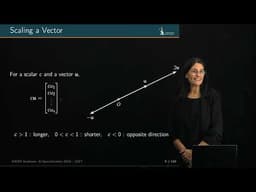
- [8:31] Scaling vectors, subtraction, and the effect of scalars greater than 1, between 0 and 1, and negative
- [10:05] Linear combinations and how they generate lines and planes through the origin
- [12:08] Span of one or two vectors, and why spans always contain the zero vector
- [15:19] RGB color model as a real-world example of linear combinations (yellow, gray)
Key Takeaways
- [2:13] A vector is an ordered list of numbers, and its dimension (size) is the number of entries, such as a four-entry vector with dimension 4.
- [3:14] A house with area 120 square meters and 3 bedrooms is represented as the vector (120, 3) in R², which is how data points become vectors for ML.
- [6:25] In R³, the standard unit vectors are e1 = (1, 0, 0), e2 = (0, 1, 0), and e3 = (0, 0, 1).
- [7:28] Vector addition adds corresponding components, and geometrically it is the diagonal of the parallelogram formed by the two vectors.
- [8:31] Scaling by c multiplies every component by c: c > 1 lengthens the vector, 0 < c < 1 shortens it, and negative c reverses its direction. Subtraction u − v is computed as u + (−1)v.
- [10:05] A linear combination c₁u₁ + … + cₘuₘ is formed by scaling and adding vectors, and the set of all such combinations is called the span.
- [12:08] The span of one nonzero vector is a line through the origin, and the span of two vectors (in R³, not parallel) is a plane through the origin.
- [15:19] In the RGB model, adding red (1, 0, 0) and green (0, 1, 0) gives yellow (1, 1, 0), and 0.5 times each primary gives gray (0.5, 0.5, 0.5).
Action Items
- Work the six exercises the instructor recommends after each module, since practice is what makes the notation stick.
- Sketch u + v, 2u, −u, and u − v on paper for two 2D vectors to build geometric intuition.
- Represent a few real objects as feature vectors (for example, area and bedrooms for houses), as the lecture does.
- Mix RGB values in a color tool or code to see linear combinations producing colors.
Caveats
- The transcript ends partway through Module 1 (during the RGB gray example), so it does not cover matrices or regression, despite the course outline.
- The notation is sometimes confusing: X is used for both a data point and a feature vector, and "R²" is described loosely as having "an X value and a Y value."
- The transcript appears auto-generated, with filler words and non-speech tags like [sighs], [snorts], and [clears throat]. Some sentences are garbled, so checking the original video or slides is advisable for exact wording.
- The claim that the course includes six exercises per module is stated by the instructor and was not verified.