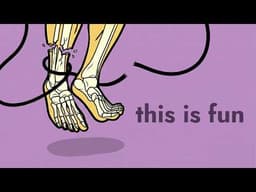
30 Days of Jump Rope: A Calisthenics Athlete's Beginner Journey
AI summary of “30 Days of Jump Rope: A Calisthenics Athlete's Beginner Journey” by Yellow Dude, generated by Sumvid.
Title
30 Days of Jump Rope: A Calisthenics Athlete's Beginner Journey
One-Sentence Summary
A strength-focused creator documents a month of learning jump rope with a weighted rope, sharing the form fixes that helped him progress and promoting the Crossrope system and app along the way.
Worth Watching If
You're a strength or calisthenics trainee who dislikes cardio and wants an entertaining, relatable beginner's diary with some practical form tips. Much of it is a personal story with a product pitch, and the core tips (small hops, wrist rotation, looking forward) are common jump rope advice.
Chapters
- [0:01] Day 5 hook: shin pain from a weighted rope, and the creator's cardio struggles
- [0:32] Day 1: the first attempts fail, and a heavier rope helps with timing
- [2:06] Day 2 onward: sore shoulders lead to the discovery that the wrists should turn the rope
- [3:12] Days 3–5: jumping too high causes tripping, so the creator learns to hop about an inch and fixes rope length
- [4:44] Days 6–8: overthinking a list of form cues makes performance worse
- [5:46] Days 9–12: forgetting about form produces the first real rhythm
- [6:50] Days 13–17: alternate-foot jumping fails until the creator learns to look forward
- [8:56] Days 25–30: progression to double unders and an overview of Crossrope weights and app features
- [12:31] Conclusion: a beginner's takeaway and a call to comment
Key Takeaways
- [0:32] Starting fitness was low: the creator could do 18 pull-ups but quit after about 30 seconds of jumping.
- [2:38] Shoulder burn came from "helicoptering" the arms; turning the wrists to move the rope fixed it.
- [3:42] Jump only about an inch off the ground, since high jumps waste energy and make the rope catch the shins.
- [3:42] Rope length matters: stand on the middle of the rope, with handles reaching the armpits. A rope that is too long bounces onto the shins.
- [4:44] Trying to track seven form cues at once caused tripping; "analysis paralysis" made things worse.
- [7:55] Looking forward at a wall instead of at the rope, and feeling the rope pass, unlocked alternate-foot jumping by day 24.
- [9:57] Reported progress: from 10 jumps and 30 seconds of cardio to 10 continuous minutes of basic bounce and 2–3 minutes of alternate feet in 30 days.
- [10:59] Crossrope's swappable weights are presented as useful: a heavier rope (about 1 lb) for learning timing and a lighter one (about ¼ lb) for speed and endurance.
- [11:31] The app is claimed to burn 20% more calories than training without it and offers 2,500+ guided workouts and an AI trainer.
Action Items
- Start with a small, low hop (about an inch) and practice the motion without a rope first.
- Set rope length so you stand on the middle with handles at armpit height.
- Keep elbows at your sides and turn the rope with your wrists, not your shoulders.
- Look straight ahead rather than at your feet, and rely on feeling the rope pass.
- Practice in short, focused sessions and avoid thinking through every form cue mid-jump.
- If you want structure, try a guided program, though a basic rope can work too.
Caveats
- Product promotion: Crossrope is featured prominently, including app features and pricing-related claims. The video does not clearly disclose a sponsorship, so treat the product recommendations with that in mind.
- Unsourced claim: The "20% more calorie burn" figure has no stated basis or study.
- Anecdotal evidence: Results, weight loss, and "best cardio I found" are personal experience, not controlled comparisons.
- Subjective framing: Calling it "the best cardio" and comparing it to treadmills is opinion presented as fact.