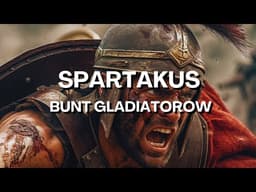
Spartacus: The Gladiator Who Challenged Rome
AI summary of “Spartacus: The Gladiator Who Challenged Rome” by Okiem Ciekawości, generated by Sumvid.
Title
Spartacus: The Gladiator Who Challenged Rome
One-Sentence Summary
This video traces Spartacus's life from Thracian auxiliary soldier to gladiator, through his escape and his rebel army's march across Italy, to his defeat by Crassus in 71 BCE and the crucifixion of thousands of captured rebels.
Worth Watching If
You want a clear, narrative overview of the Third Servile War for general interest. It is not a source for scholarly detail, since it relies on sparse ancient accounts and includes speculation and some questionable claims.
Chapters
- [0:03] Introduction to Spartacus's uncertain origins as a Thracian who served as an auxiliary soldier in the Roman army
- [1:06] Description of Thracian warriors and Spartacus's early life, followed by his desertion and sale into gladiatorial training
- [2:40] Life at the Capua gladiator school, the planned escape, and the break out of the kitchen
- [4:45] The rebels' retreat to Mount Vesuvius and early Roman responses to the uprising
- [8:24] Spartacus's successful night attack on the Roman camp at Vesuvius and the defeat of Glaber and Vinius
- [10:30] Disagreement between Spartacus and Crixus, and the decision to march south
- [12:33] Winter preparations, the rebels' northward plan, and the Roman consuls' response
- [13:36] Victories over Roman forces and the funeral games for Crixus
- [15:39] Spartacus's decision not to attack Rome, and Crassus's appointment and army
- [17:13] Mummius's defeat and Crassus's decimation of his legions
- [18:45] Crassus's wall across the toe of Italy and the failure of the planned crossing to Sicily
- [20:19] Escape from the siege during a snowstorm, and the crucifixion threat
- [21:20] Defeat of Crixus's group, then the final battle and Spartacus's death
- [22:52] Crucifixion of about 6,000 rebels along the Appian Way and closing reflections
Key Takeaways
- [0:03] Spartacus likely came from the Maedi or nearby Thracian region, and he was not born a slave. He first served as an auxiliary cavalry soldier in the Roman army.
- [2:08] After deserting, Spartacus was captured and sentenced to become a gladiator (murmillo) at the Capua school run by Gnaeus Cornelius Lentulus Batiatus, rather than being crucified like other deserters.
- [4:14] The rebels escaped from the Capua school in 73 BCE after a planned revolt was betrayed, and they seized weapons from a cart headed to another gladiator school.
- [5:18] The rebels took refuge on Mount Vesuvius, which offered a natural fortress and an observation point.
- [6:21] Italy had roughly two million slaves out of a population of about six million, and Rome had become very wealthy and powerful through conquest.
- [7:22] Rome was fighting two costly wars at opposite ends of the Mediterranean, which left Italy defended mainly by second- and third-rate troops.
- [9:26] Spartacus led a night attack down an unguarded side of Vesuvius, using rope made from wild vines, and routed the Roman camp.
- [12:01] After defeating Gaius Claudius Glaber and Publius Varinius, the rebels captured fasces, and their army grew to about 40,000 warriors.
- [13:04] After Crixus split off and was killed at Mount Garganus, Spartacus marched north and freed slaves, and his army defeated two consular armies.
- [16:10] Marcus Licinius Crassus, one of Rome's richest men, raised six new legions and led an army of about 45,000 men against the rebels.
- [18:45] Crassus built a wall of about 35 miles across the toe of Italy, which trapped the rebels after their planned crossing to Sicily failed.
- [20:19] Spartacus escaped Crassus's siege during a snowstorm in early 71 BCE, and most of his army got out.
- [22:21] Spartacus was killed in the final battle in Apulia, and his body was never identified.
- [22:52] Crassus crucified about 6,000 captured rebels along the Appian Way from Capua to Rome, which ended the revolt.
Caveats
- The transcript appears to be auto-generated and contains some garbled names and words, so specific details should be verified against a reliable source.
- Several claims are presented as fact without evidence or citation. Examples include the claim that the Senate rejected distinctive clothing for slaves, the description of Hannibal being stopped by Rome's walls, and the alleged pirate alliance and Sicily plan, which are described as theories.
- The speaker says Spartacus "probably never seriously considered" attacking Rome, which is speculation.
- Troop numbers, ages, and monetary values (such as the sestertius-to-euro conversion) vary across ancient sources and are presented without caveats.
- The speaker's claim that Spartacus did not seek to overthrow the social order is an interpretation, not a settled conclusion.
- No sponsor appears in the video. The only promotion is a reference to a previous video on Roman baths.