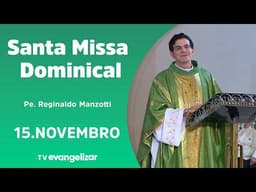
Sunday Mass for the World Day of the Poor: Using Your Talents Without Fear
AI summary of “Sunday Mass for the World Day of the Poor: Using Your Talents Without Fear” by TV Evangelizar, generated by Sumvid.
Title
Sunday Mass for the World Day of the Poor: Using Your Talents Without Fear
One-Sentence Summary
A full Catholic Mass from the Santuário de Nossa Senhora de Guadalupe in Brazil, in which Father Reginaldo Manzotti uses the Parable of the Talents to urge the faithful to put their gifts into service rather than bury them out of fear.
Worth Watching If
You want a complete, prayerful Mass in Portuguese or an illustrated reflection on the Parable of the Talents (Matthew 25:14-30) and the role of fear in Christian service. It is mostly liturgy and song; the homily (roughly 18:00 to 36:00) is the substantive part, and it is a devotional sermon rather than theological analysis.
Chapters
- [3:12] Opening rites: greeting, penitential rite, and the Gloria
- [6:19] Prayers of intention, collection of names for prayer, and the opening prayer
- [7:55] First reading (Proverbs 31): the "strong woman" who works diligently with her hands
- [8:59] Responsorial Psalm 127 ("Happy are those who fear the Lord")
- [11:36] Second reading (1 Thessalonians): the day of the Lord comes unexpectedly, so stay watchful
- [14:11] Gospel (Matthew): the Parable of the Talents
- [18:19] Homily begins: the central theme is how we handle gifts beyond our natural abilities
- [24:05] Homily: talents must be used or they are lost; distinction between aptitude and talent
- [29:23] Homily: the fearful servant, and how a distorted image of God produces fear
- [30:56] Homily: Pope Francis on taking risks, and the "plaster cast" metaphor for stagnation
- [36:44] Creed and prayers of the faithful
- [40:54] Offertory, Eucharistic Prayer, and Communion
- [54:26] Closing announcements: a spiritual diary, a renovation fundraiser, and upcoming events
Key Takeaways
- [14:11] The parable: a master entrusts five, two, and one talents "according to each one's capacity." The first two servants double their share and are praised; the third buries his talent out of fear and is condemned as "wicked and lazy."
- [18:19] The priest argues that the parable is not mainly about artistic or practical skills. Its central theme is how we handle gifts that go beyond natural abilities, which he describes as gifts entrusted by Christ for the Church's mission.
- [24:05] Core principle: "Nobody spends a talent. The more you use it, the more it flows." Unused charisms, he says, can be lost.
- [24:38] He separates aptitude (innate ability, such as singing well) from talent (aptitude placed at the service of the Kingdom, such as using music to evangelize). He says God works through aptitude but turns it into a talent when it is put to use.
- [25:41] Proverbs 31 is read as praise for diligence and virtue, with the priest noting that most parish volunteers are women and thanking them.
- [29:23] Fear is identified as the main obstacle, and he says fear is rooted in a distorted image of God as a strict judge or traffic cop.
- [30:56] He cites Pope Francis's encouragement to take initiative and accept that mistakes will happen, contrasting this with communities that reject every innovation.
- [33:35] The "bank" in the parable is interpreted as the Church: the talent should be invested in the community, which would guide its use.
- [34:38] The homily's closing prayer asks the Holy Spirit for freedom from fear, creativity, and passion for the Gospel.
Action Items
- Identify one gift or ability you have not used for the Church or your community, and commit to using it in a concrete way this week.
- Distinguish between your natural aptitudes and how you put them at the service of others, and ask where your talents could serve the parish.
- Notice when fear or perfectionism is stopping you from acting, and name the image of God behind that fear.
- Pray the Holy Spirit's guidance over your projects, as the homily recommends, before you start them.
- Reflect on the "plaster cast" question: where in your life have you become stuck, and what small step would free you?
Caveats
- Donation appeals: The Mass includes repeated requests for offerings, including QR codes, a Pix payment key for a church renovation, a year-end "Menino Jesus" campaign, and a spiritual diary for sale. These are fundraising calls from the ministry, not paid sponsorships, but viewers should be aware of them.
- Interpretation, not scholarship: The homily presents one interpretation of the parable (talents as the Church's mission) as the central theme. Biblical scholars read the parable in several ways, and the priest does not discuss alternatives.
- Unverified quotations: The Pope Francis remarks are paraphrased and not sourced, so they should be checked before being quoted.
- Doctrinal distinctions: The priest clarifies that the "loss of anointing" he discusses is not sacramental. Viewers unfamiliar with Catholic terminology may find this distinction confusing.
- Rapid speech and crowd noise: Much of the transcript includes hymns and background sounds, so auto-generated captions may contain errors.