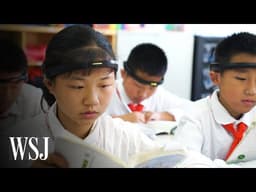
China's Classrooms Are Testing AI Brain-Wave Headbands on Students
AI summary of “China's Classrooms Are Testing AI Brain-Wave Headbands on Students” by The Wall Street Journal, generated by Sumvid.
Title
China's Classrooms Are Testing AI Brain-Wave Headbands on Students
One-Sentence Summary
A report from a Shanghai-area primary school shows how China is using EEG headbands, facial recognition, and other AI tools to monitor student attention, raising questions about accuracy, pressure on children, and data privacy.
Worth Watching If
You want a short, visual overview of AI surveillance in Chinese schools, especially if you're interested in education technology or privacy. It is a news-style piece with little technical depth, so it works better as a snapshot than as an explanation of how the systems work.
Chapters
- [0:01] Introduction: headbands measure student concentration and send data to teachers and parents, set against China's wider AI and surveillance push
- [0:33] Overview of China's AI ambitions, including facial-recognition payments and police surveillance
- [1:05] Other school tech: robots tracking health, uniform chips tracking location, cameras counting phone checks and yawns
- [1:36] Government funding and the scale of the education AI experiment
- [2:07] A fifth-grade class uses the EEG headband during math, with a device description
- [2:38] Attention reports sent to parents' chat groups at 10-minute intervals
- [3:08] Reporter tries the headband; a neuroscientist from UCSF comments on its limited research base
- [3:38] Explanation of EEG's sensitivity to noise and poor electrode contact
- [4:10] Teachers report better attention and higher scores, alongside student pressure
- [4:40] A student describes punishment for low scores; unclear data handling and likely weak privacy protection
- [5:13] Closing: experts and citizens raise alarms about the broader AI push
Key Takeaways
- [0:01] The headband has three electrodes (two behind the ears, one on the forehead) and sends brain-signal data to the teacher's computer in real time during lessons.
- [2:38] Teachers receive per-student concentration levels at 10-minute intervals, and parents receive class reports through a chat group.
- [1:05] Other monitoring includes cameras that track how often students check their phones or yawn, uniform chips that track location, and robots that analyze health and engagement.
- [1:36] The government has invested billions of dollars in the program, which brings together tech giants, startups, and schools.
- [3:38] Neuroscientist Theodore Zanto explains that EEG is very susceptible to artifacts such as itching, fidgeting, or poor electrode contact, which can distort readings.
- [3:08] Zanto notes that the technology has relatively little research behind it, and it is normally used by doctors in hospitals and labs, not in classrooms.
- [4:10] Teachers say the headbands have made students more disciplined, that attention has improved, and that scores have risen.
- [4:40] A fifth grader says his parents punish him for low attention scores, which the report describes as adding a new kind of pressure.
- [4:40] Companies said the data may go to government-funded research, and parents were unclear where it ends up. Zanto says there is likely no privacy protection.
- [0:33] The video places the school experiment within a broader context: China's facial-recognition payments, a large surveillance-camera network, and a national goal of AI leadership.
Caveats
- The school-level claims (better attention, higher scores) come from teachers and are not backed by data shown in the video.
- The reporting relies on one school visit and a small number of interviews, so it may not represent schools across China.
- The "likely no privacy protection" point is an expert's assessment, not a documented finding about the actual data practices.
- The video does not establish whether the headbands measure concentration accurately. The only expert comment is cautionary.
- The transcript appears to contain transcription errors (for example, the scientist's name and some words), so some quotes may be imprecise.
- The video uses dramatic music and framing ("alarmed netizens," "laboratories for future generations") that leans toward a critical tone.