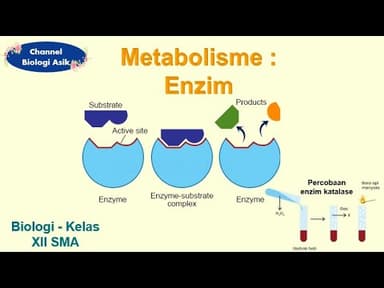
AI summary of “Metabolisme part 1 - Enzim - Biologi kelas 12 SMA” by Channel Biologi Asik , generated by Sumvid.
Title
Understanding Enzymes: Structure, Properties, Function, and the Catalase Experiment
One-Sentence Summary
This educational video explains the complete concept of enzymes for grade 12 biology students, covering their molecular components, properties, mechanisms of action, factors affecting their activity, and a practical catalase enzyme experiment.
Key Takeaways
- [0:33] Enzymes are primarily composed of two main components: apoenzymes (proteins) and prosthetic groups (cofactors and coenzymes), with the complete complex called a holoenzyme; zymogens are inactive enzyme precursors activated only when and where needed to prevent self-degradation.
- [4:43] Enzymes possess nine key properties: they are proteins, work specifically (each enzyme targets specific substrates), are thermolabile (heat-sensitive), function as biocatalysts, are needed in small quantities, are reversible, don't determine reaction direction, don't change chemical equilibrium, and can be reused until damaged.
- [9:58] Two theories explain enzyme function: the lock-and-key theory posits that enzyme active sites are rigid and must precisely match substrate shapes, while the induced-fit theory suggests active sites are flexible and adjust to accommodate substrate shapes.
- [12:33] Temperature significantly affects enzyme activity, with cold temperatures deactivating enzymes, optimal activity occurring at 30-40°C, and temperatures above 40°C causing enzyme denaturation—this principle is applied in food preservation through refrigeration.
- [14:38] Enzyme activity is influenced by multiple factors: pH varies by enzyme location (acidic for stomach enzymes like pepsin, neutral in mouth, alkaline in intestines); enzyme concentration is directly proportional to reaction rate; substrate concentration increases reaction rate only until all enzyme active sites are occupied.
- [16:44] Inhibitors reduce enzyme activity in two ways: competitive inhibitors compete with substrates for active sites (can be overcome by adding more substrate) and non-competitive inhibitors bind to allosteric sites, changing the enzyme's active site structure (cannot be overcome by adding substrate).
- [20:23] The catalase enzyme experiment uses chicken liver extract containing catalase enzyme, which breaks down toxic hydrogen peroxide (H₂O₂) into harmless water and oxygen gas; observable bubbles and flame reactions demonstrate enzyme function and allow testing of variables like temperature, pH, and substrate concentration.
Suggested Category Tags
Education, Biology, Enzymes, High School Science, Biochemistry
Want a summary like this for your own video?
Summarize your own video — free