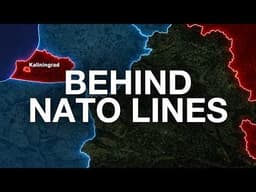
Why Putin's Nuclear Threats Over Kaliningrad Matter: Russia Baiting NATO
AI summary of “Why Putin's Nuclear Threats Over Kaliningrad Matter: Russia Baiting NATO” by WarFronts, generated by Sumvid.
Title
Why Putin's Nuclear Threats Over Kaliningrad Matter: Russia Baiting NATO
One-Sentence Summary
The video argues that Putin's nuclear warnings about the Kaliningrad exclave, combined with Russian military probes and hybrid attacks, are an attempt to bait NATO into firing the first shot and fracture the alliance's unity under Article 5.
Worth Watching If
You follow Russia-NATO tensions and want a single framework for connecting recent events (the Valdai speech, the September helicopter incursion, the Black Sea drone attack, the Latvian border incident). Much of the central argument rests on speculative hypotheticals, so treat it as one informed interpretation rather than reporting.
Chapters
- [0:00] Putin's nuclear warning at the Valdai forum and why it alarmed observers
- [1:03] Kaliningrad's military assets: Baltic Fleet, Iskander missiles, S-400s, and troops
- [2:36] NATO's containment posture, including fortifying the Suwałki Gap and Baltic Defense Line
- [4:09] Putin's framing that NATO threatens Kaliningrad, and NATO's unannounced exercises
- [6:43] Russian readiness signals and Kaliningrad's limited mobilization planning
- [7:45] The September 23 Russian helicopter airspace violation over Poland
- [9:15] Drone attack on ships in Bulgaria's EEZ and the Latvian migrant border incident
- [11:19] Thesis: Russia is trying to make NATO fire the first shot
- [12:21] Hypothetical Article 5 test case involving a small disputed island
- [13:53] Hypothetical escalation scenario after a shootdown of the helicopter
- [16:27] Hypothetical Latvian border shootout and NATO's response dilemma
- [18:01] Conclusion: Kaliningrad as the focal point, and the false-flag risk
Key Takeaways
- [0:00] Putin said at the Valdai forum that if Russia is directly attacked, "the question of the Russian Federation deploying all the weapons at our country's disposal will... inevitably and immediately be on the agenda."
- [1:03] Kaliningrad (about the size of Connecticut, roughly one million people) hosts the Baltic Fleet, Iskander missiles capable of nuclear payloads, S-400 air defenses, fighter squadrons, and thousands of troops.
- [2:36] NATO's containment approach includes monitoring Belarus troop movements, fortifying the 65 km Suwałki Gap, and building the Baltic Defense Line.
- [4:09] Putin claims Russia has no plans to attack Europe, while citing Poland's military expansion and the Baltic Defense Line as threats.
- [6:43] Russia's Northern Fleet is largely uncommitted to Ukraine, which the video presents as capacity for reinforcing Kaliningrad.
- [7:45] On September 23, a Russian Mi-8 helicopter entered Polish airspace about 300 m and stayed for 42 seconds; Poland scrambled fighters but did not shoot it down, though it later changed its rules of engagement.
- [9:15] On October 6, drone attacks on two cargo ships in Bulgaria's EEZ sank one vessel with 10 crew presumed dead, and the video attributes the attack to Russia's drone operations.
- [11:19] The video's core thesis: Russia wants to provoke NATO into firing first so it can blame NATO and fracture the alliance's Article 5 unity.
- [12:21] The video argues that a limited seizure of a disputed island might not trigger a full NATO response, which would weaken the alliance's credibility.
- [18:01] The video concludes that the Kaliningrad focus may set up a false-flag attack if NATO doesn't take the bait.
Caveats
- Sponsored segment: A mid-video pitch promotes the Warfronts premium subscription ($5/month or $50/year). The presenter's outlet is the source of the analysis.
- Hypotheticals presented as analysis: The Finnish island scenario, the helicopter-shootdown scenario, and the Latvian shootout scenario are invented to illustrate points. The shootout is described in vivid detail but is not an event that occurred.
- Speculation stated as fact: Claims such as "Russia's goal is to start a limited conflict" and "Putin doesn't seem to actually believe any of this" are interpretations of intent, not established findings.
- Selective sourcing: Only one named official (former Estonian NATO ambassador Yuri Luik) is quoted, and the Wall Street Journal report about Kaliningrad mobilization planning is cited without detail. Attribution for the Black Sea attack to Russia is asserted, not demonstrated, and the video itself notes Bulgaria's prime minister did not immediately blame Russia.
- Possibly dated: The video refers to events from 2025 and early October; verify current status before relying on the specifics.