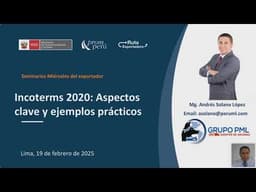
Incoterms 2020 for Exporters and Importers: Why They Matter (Peru Trade Session)
AI summary of “Incoterms 2020 for Exporters and Importers: Why They Matter (Peru Trade Session)” by PROMPERÚ Oficial, generated by Sumvid.
Title
Incoterms 2020 for Exporters and Importers: Why They Matter (Peru Trade Session)
One-Sentence Summary
A Peruvian trade educator explains how Incoterms 2020 allocate delivery, risk, cost, and documentation duties in international sales, and uses practical examples to show why exporters and importers should choose and write them into contracts deliberately.
Worth Watching If
You are a Spanish-speaking exporter, importer, or trade student who wants a practical introduction to Incoterms with real-world examples and Peru-specific customs references. It is long and often meandering, and much of it covers basics that are widely available elsewhere, so readers with trade experience may only get value from the pricing example and the insurance discussion.
Chapters
- [0:00] Opening remarks on the importance of trade training and why Incoterms 2020 matter in today's changing trade environment
- [3:08] Incoterms as a roadmap defining obligations, rights, and cost and risk positions in a sale
- [8:59] Why companies need a written export strategy and an audit of their critical points
- [10:06] Case study: an importer's cheap CFR purchase that ended with unexpected destination costs
- [14:14] The four core questions Incoterms answer: where delivery occurs, when risk transfers, how costs are split, and which documents apply
- [19:32] History of Incoterms, from early definitions in the 1800s through the 1936 first ICC version to the 2020 edition
- [29:30] Where Incoterms appear (insurance, banking, transport contracts) and why they cover goods, not services
- [35:20] Insurance cost comparison: statistical customs insurance versus an actual policy
- [40:32] Why exports are measured at FOB and imports at CIF-based values in Peruvian statistics
- [56:20] Overview of the four Incoterm groups (E, F, C, D) and the transport modes each serves
- [1:21:31] Worked pricing example for 10,000 cotton shirts comparing EXW, FOB, CFR, and DDP
- [1:24:39] Q&A on insurance, claims, and how the chosen Incoterm determines liability
Key Takeaways
- [3:08] Incoterms define delivery point, risk transfer, and cost responsibility, and they are meant to reduce ambiguity and legal disputes in cross-border sales.
- [14:14] The speaker frames Incoterms around four questions: where goods are delivered, where risk transfers, how costs are distributed, and which trade documents each party must handle.
- [10:06] A cheap CFR purchase can backfire: the importer received a large destination bill (arrival notice and port, customs, and transport costs) and had no control over those charges, so the speaker recommends buying FOB and controlling freight yourself.
- [30:02] CIF insurance typically ends at the port of arrival (Callao in the example), so the buyer may be uninsured inland unless they buy their own cargo policy.
- [34:15] Using a statistical insurance rate of 2% on a $200,000 shipment gives $4,000, versus roughly $600 for an actual policy at about 0.3%; the speaker argues the real policy saves on taxes calculated on the higher value.
- [39:31] Peru's official export statistics are reported at FOB because FOB captures all Peruvian-generated value up to loading, and the speaker argues this reflects the multiplier effect of exports.
- [45:19] The ICC has issued revisions in 1936, 1953, 1967, 1976, 1980, 1990, 2000, 2010, and 2020, with roughly ten-year cycles since 1980.
- [50:38] Incoterms are recommendations recognized as international practice, not laws; they do not determine property transfer, and they do not cover everything (for example, cold-chain breaks after delivery).
- [1:21:31] In the shirt example (cost $51,000 at FOB, $53,500 at CFR), the speaker shows how each added term raises both the price and the seller's exposure, and he recommends FOB for most exporters rather than DDP.
Action Items
- Before pricing an export or import, build a full cost structure (origin, freight, insurance, destination charges, duties) and compare the margin under each candidate Incoterm.
- Choose Incoterms deliberately and write the exact term, including the named place (for example, "FOB Callao"), into the sales contract, invoice, and transport documents.
- Buy your own cargo insurance rather than relying on CIF or CIP minimum coverage, and align the policy's beneficiary and coverage period with the chosen Incoterm.
- Ask your insurer or broker to match the policy to the Incoterm's risk-transfer point and cover the full route to your warehouse.
- Obtain the ICC Incoterms 2020 official guide and read the rules for the terms you use, since the speaker notes the details are in the fine print.
- For Peruvian exports, review SUNAT's definitive export procedure (PG02) to confirm exporter obligations such as the customs mandate and the 30-day regularization period.
- Check how customs or banks in your country will treat any older Incoterm version you cite, since the speaker notes they may require an equivalence letter.
Caveats
- The transcript is auto-generated and contains many errors, including garbled Incoterm names (for example, "xword" for EXW) and unclear figures. Verify all numbers and rules against the official ICC text before relying on them.
- The worked examples (the 2% statistical insurance rate, the roughly 12% tax burden, and the 40% margin for shirts) are illustrative. Rates and tax treatment vary by product, tariff heading, and year.
- Much of the regulatory guidance is specific to Peru (SUNAT, the General Customs Law, export procedures and statistics). It does not apply directly elsewhere.
- Some claims, such as the historical timeline and the 1812 date for the first FOB term, are presented without sources and should be checked.
- The speaker invites viewers to follow him on LinkedIn, which is a self-promotional call to action rather than a sponsorship. No formal sponsor was identified.