Corporatism in Mexico: How the PRI Organized Labor and Peasants
AI summary of “Corporatism in Mexico: How the PRI Organized Labor and Peasants” by Steven Johansson, generated by Sumvid.
Title
Corporatism in Mexico: How the PRI Organized Labor and Peasants
One-Sentence Summary
The video explains corporatism as the state-controlled relationship between Mexico's ruling party (PRI) and its labor, peasant, and popular organizations, and contrasts it with clientelism.
Worth Watching If
You are new to Mexican political history or want a short, definition-first overview of corporatism and how it differed from clientelism. It is brief and factual, but it does not analyze why the system lasted or how it ended, so it works better as an introduction than as a deep study.
Chapters
- [0:01] Defines corporatism using Philippe Schmitter's definition and introduces its use in Mexico
- [1:04] Describes the Cárdenas-era alliance in which the state exchanged benefits for loyalty
- [1:35] Lists the PRM's sectors (labor, peasant, military) in 1938 and the 1946 change to the popular sector
- [2:06] Gives 1978 union membership figures and the strength of corporate groups in Congress
- [3:10] Explains the decline of labor's influence in the PRI's congressional faction after 1979
- [3:41] Covers the 1997 departure of major unions from the PRI
- [4:18] Names the three main peak organizations: CTM, CNC, and CNOP
- [4:50] Summarizes the history of CROM and the leadership of Fidel Velázquez and later leaders
- [6:54] Describes the CNOP's composition and the scale of these confederations
- [7:24] Defines clientelism and contrasts it with corporatism's formal character
Key Takeaways
- [0:01] Schmitter's definition: the state recognizes certain organizations as representatives of social groups in exchange for controls over how they choose leaders and articulate demands.
- [1:04] Under Cárdenas, the state gave labor and peasant organizations jobs, subsidies, and benefits (workers) or land and credit (peasants) in return for loyalty to the regime.
- [1:35] The PRM was organized into labor, peasant, and military sectors in 1938; the Popular Sector replaced the military sector in 1946.
- [2:06] In 1978 the Congreso del Trabajo reportedly affiliated 83.9% of workers under Apartado A (private sector) and 99.8% under Apartado B (state employees).
- [3:10] Labor's share of the PRI's Chamber of Deputies faction fell from 31.4% in 1979 to less than one-fifth by 1997.
- [3:41] From 1997, several major unions, including the IMSS workers' union and the telephone workers' union, left the PRI.
- [4:18] The three peak confederations were the CTM (labor), the CNC (peasants), and the CNOP (popular sector).
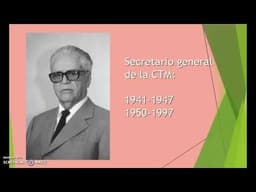
- [4:50] Fidel Velázquez led the CTM for 53 years, including 1941–1947 and 1950–1997; Carlos Aceves del Olmo was the current leader at the time of the video.
- [6:23] The CNC, founded in 1938, was the main peasant organization, with Antorcha Campesina as another group in the sector.
- [7:24] Clientelism is an informal, reciprocal, unequal patron-client exchange of favors, support, and votes, whereas corporatism is formal and institutionalized.
Caveats
- The transcript is auto-generated and contains errors, so some names and terms may be misheard (for example, "gules" and "CROC" in places).
- The 1978 and 1979 membership and faction figures are given without sources.
- The video contradicts itself on the CNOP's founding date, stating 1936 at one point and 1943 at another.
- The summary of CROM's replacement by the CNOP is a simplification of a more complex organizational history.
- The video presents a single definition of corporatism and does not discuss competing scholarly interpretations.