Theory of Balinese Kerawitan 2: History, Classification, and Instrumental Traditions of Balinese Gamelan
Tusti Channel39:14Open on YouTube ↗
AI summary of “Theory of Balinese Kerawitan 2: History, Classification, and Instrumental Traditions of Balinese Gamelan” by Tusti Channel, generated by Sumvid.
Title
Theory of Balinese Kerawitan 2: History, Classification, and Instrumental Traditions of Balinese Gamelan
One-Sentence Summary
This educational tutorial explores the history, classification, and characteristics of Balinese gamelan music, categorizing it into old, middle, and new class instruments and explaining their cultural significance and instrumentation.
Key Takeaways
- [0:32] Balinese Kerawitan 2 focuses on instrumental vocal art, specifically Balinese gamelan, building upon the vocal traditions covered in Kerawitan 1
- [1:44] Balinese gamelan is inseparable from Balinese religion and culture, with no religious ceremony being complete without gamelan or dance participation, which has attracted international ethnomusicologists and composers to study this tradition
- [4:21] Balinese gamelan is classified into three historical periods: old class gamelan (gambang, saron, slonding, angklung), middle class gamelan (gambuh, semar pegulingan, pelegongan, bebarongan), and new class gamelan (gong kebyar, arje gamelan, joget bumbung)
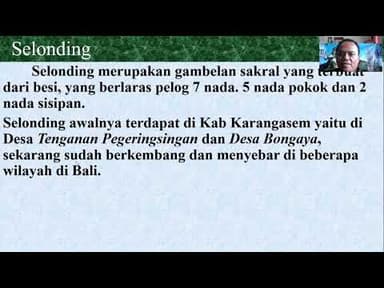
- [8:45] Old class gamelan like slonding is a sacred iron instrument with seven-tone pelok tuning that originated in Karangasem Regency and has ceremonial functions, particularly in cremation ceremonies
- [13:13] Gender wayang is a bladed instrument with 10 notes and slendro scale used to accompany Balinese shadow puppet performances, employing advanced two-beater playing techniques with interlocking figuration patterns
- [23:54] Middle class gamelan's defining characteristic is the inclusion of the kenang (drum) as a rhythmic regulator that controls speed, loudness, and determines song form through distinctive drum motifs
- [26:10] Gamelan gambuh serves as the foundational source of Balinese music, from which the tuning systems, song repertoires, and drum patterns of subsequent gamelan types have been derived
- [36:41] The new class gamelan, exemplified by gong kebyar (created in 1915 in Buleleng), is characterized by a dominant kendang role, more elaborate drum patterns, smaller flutes for melody, and greater compositional freedom compared to classical gamelan