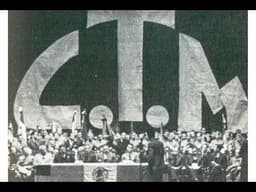
The Origins of Mexican Labor Unionism: From Early Workers' Associations to the CROM
3:53English
AI summary of “The Origins of Mexican Labor Unionism: From Early Workers' Associations to the CROM”, generated by Sumvid.
Title
The Origins of Mexican Labor Unionism: From Early Workers' Associations to the CROM
One-Sentence Summary
The video traces how Mexican workers organized from the first labor associations of the 1870s through the Mexican Revolution, the founding of the CROM, and the economic crisis of 1929.
Worth Watching If
You want a brief, introductory overview of the early history of Mexican unions and their links to the Revolution. It is short and general, so it will not satisfy anyone looking for depth, sources, or analysis.
Chapters
- [0:07] Introduction to the long struggle of Mexican workers and the history of unionism in Mexico
- [0:37] First workers' association in the 1870s, the working class's role under the late-19th-century liberal government and Porfirio Díaz's dictatorship, and the consolidation of unions after the Revolution
- [1:08] Workers courted by rival political groups on the eve of the 1910 Revolution
- [1:38] Organizing the proletariat, the first May Day commemoration in 1913, and the Flores Magón brothers' warnings to workers
- [2:09] Founding of the CROM during the Revolution and its alignment with Obregón and the Sonorans against Carranza
- [2:42] Gains from the Revolution, including Article 123 of the 1917 Constitution, and the CROM's decline after Obregón's death
- [3:12] The end of the formative period of Mexican unionism and the push to form a stronger central labor organization
- [3:43] The 1929 crisis, rising living costs, worker overexploitation, and the return of Mexicans deported from the United States
Key Takeaways
- [0:37] The first association to defend workers' rights in Mexico was founded in the 1870s, which the video presents as the start of organized labor.
- [1:08] Rival political groups courted workers on the eve of the 1910 Revolution, and the video says the proletariat was seen as a mass whose organization was urgent.
- [1:38] The first May Day commemoration in Mexico took place in 1913, and political leaders recognized the working class as "the decisive element" in collective forces.
- [2:09] The CROM (Confederación Regional Obrera Mexicana) was born during the Revolution, from a conflict between General Álvaro Obregón and Venustiano Carranza, and it sided with the Sonorans.
- [2:42] Article 123 of the 1917 Constitution is cited as the key labor gain of the Revolution, alongside other rights.
- [2:42] According to the video, the autonomy of workers' organizations gradually eroded over time, and after Obregón's death the CROM and its leaders lost political and labor influence.
- [3:12] The video marks the end of Mexican unionism's formative period in the 1920s and links it to a push for a more solid, decisive central labor organization.
- [3:43] The 1929 economic crisis raised the cost of living in Mexico and intensified the overexploitation of labor, compounded by the repatriation of Mexicans from the United States.
Caveats
- The transcript is machine-generated and contains errors, such as "menús tiano" for Carranza and "crom" for CROM, so some names and details may be misheard.
- The video ends abruptly, and the timeline is only partly covered. The Revolution-to-1929 period is summarized quickly.
- The phrase "tercera década de 1900" appears to be a slip for the 1920s, so the date should be verified.
- The video offers no sources or citations, so its claims, especially about the autonomy of unions and the causes of the CROM's decline, should be checked against academic histories.