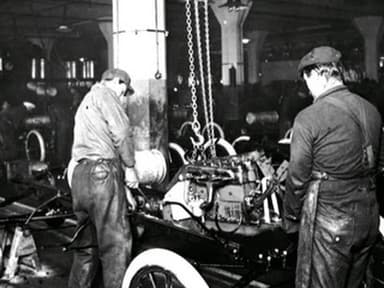
A Century of Innovation: How Ford's Assembly Line Transformed America
CBS MorningsAI summary of “A Century of Innovation: How Ford's Assembly Line Transformed America” by CBS Mornings, generated by Sumvid.
Title
A Century of Innovation: How Ford's Assembly Line Transformed America
One-Sentence Summary
The video examines the lasting impact of Henry Ford's assembly line invention from 1913, tracing its evolution from a revolutionary manufacturing concept to a modern, technology-enhanced production system that continues to shape industrial manufacturing today.
Key Takeaways
- [0:00] Henry Ford introduced the assembly line in October 1913, transforming industry worldwide and enabling mass production of the Model T, which helped create the American middle class
- [0:32] Ford's innovation came from observing meatpacking plants in Illinois where products were moved to stationary workers, which he adapted to revolutionize automobile manufacturing
- [1:02] The assembly line accomplished two major goals: it made automobiles accessible to average Americans rather than just the wealthy, and the factory employment helped establish a thriving middle class
- [1:32] Modern Ford facilities use 3D animation and virtual modeling technology to simulate assembly line processes, allowing engineers to test designs, parts, and efficiency without building physical prototypes
- [2:05] Virtual testing enables Ford to verify critical details like bolt rotation, tire fit, and antenna reach, maximizing efficiency and safety on actual production lines
- [2:35] Despite a century of technological advancement, the fundamental assembly line concept remains largely unchanged, demonstrating the enduring brilliance of Ford's original design