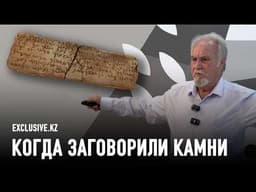
The Kangju State: Archaeological Evidence from Southern Kazakhstan
AI summary of “The Kangju State: Archaeological Evidence from Southern Kazakhstan” by Журнал Exclusive, generated by Sumvid.
Title
The Kangju State: Archaeological Evidence from Southern Kazakhstan
One-Sentence Summary
A Kazakh archaeologist argues, using Chinese written sources and his excavations, that the little-known Kangju state of Central Asia was a powerful, multi-ethnic polity that deserves recognition as an empire and as a foundation of modern Kazakh heritage.
Worth Watching If
You are interested in ancient Central Asia, the Silk Road, or Eurasian nomadic cultures and want a firsthand look at archaeological finds, including the disputed Kangju script. Be aware that it is a passionate, self-promotional lecture that often presents contested interpretations as settled, so it is best treated as one scholar's case rather than a neutral survey.
Chapters
- [0:02] The speaker frames Kangju as a little-studied state and links it to the origins of a clan he claims is among the oldest in the Kazakh zhuzes.
- [1:05] Written sources on Kangju are scarce; the speaker cites Litvinsky and describes his decades of fieldwork.
- [3:10] Chinese sources recount Zhang Qian's diplomatic mission westward and its reach into Central Asia.
- [5:14] Zhang Qian's capture by the Xiongnu and his eventual return to China.
- [9:21] The Chinese chronicle's description of Kangju: capital, five vassal territories, population, and troop numbers.
- [11:56] Kangju's role in the Han-Dayuan war and the 36 BCE campaign against Zhizhi Shanyu.
- [18:44] The debate over Kangju's location, pitting Tolstov against Bershtam, with the speaker siding with Bershtam.
- [21:21] Archaeological culture: circular settlement layouts, catacomb burials, and grave goods such as cowrie shells and Han mirrors.
- [40:28] Religious evidence: animal and male-principle cults, the Farn (Khvarna) deity, and the Kozlkol temple.
- [1:00:28] The Kangju script on clay fragments, its discovery, and its attempted decipherment.
- [1:10:56] The speaker's presentation of "eight criteria" for classifying Kangju as an empire.
Key Takeaways
- [1:05] Chinese sources, especially the Shiji and Han histories, are the main written evidence for Kangju; the speaker says the state is among the least studied in the region.
- [5:14] Zhang Qian's mission (c. 138–125 BCE) to the Yuezhi produced Chinese accounts of Kangju, including its geography, society, and military, which the speaker treats as primary evidence.
- [9:21] The Chinese chronicle, as quoted, gives Kangju a capital at Bitian, about 600,000 people, and 120,000 active-duty troops, plus five subordinate lordships.
- [12:28] Kangju's involvement in the Han–Davan war (104–102 BCE) shows it as a regional actor, though the speaker says Kangju stayed out of the fighting.
- [20:17] The speaker says excavations confirm Kangju was centered in the Syr Darya region of present-day Kazakhstan, following Bershtam over Tolstov.
- [22:23] Settlements such as Kordon-Kuzhavtobe and Tulibaitobe show circular layouts, which he links to nomadic solar symbolism.
- [1:00:28] Around 50 clay fragments in a Kangju script were found, which the speaker says show the earliest writing in Kazakhstan. He reports that Nicholas Sims-Williams associated the script with an East Iranian (proto-Sogdian) language.
- [34:39] The speaker argues nomadic societies were militarized and mobile, so they were unlikely to have a tax-based bureaucracy, which he uses to frame Kangju's distinct statehood.
- [49:29] Burials and artifacts (Sarmatian, Xiongnu, Saka elements) indicate Kangju was multi-ethnic.
- [1:13:05] The speaker claims Kangju had a written law code and a standing army, and concludes it approaches the status of ancient empires.
Action Items
- To verify the claims, read the cited Chinese sources (the Shiji and Han Shu chapters on the Western Regions) alongside archaeological publications on Kangju before accepting the interpretations.
- Compare the speaker's location and script claims with Sims-Williams's published work and other specialists' critiques.
Caveats
- Self-promotion: The speaker repeatedly highlights his own decades of work, books, and recognition, including a presentation to the French Academy, which tilts the presentation toward advocacy.
- Nationalist framing: The speaker ties Kangju directly to the ancestry of modern Kazakhs, to clan lineages (the Shanyshkyly clan's "2,000-year-old" sign), and to present-day national pride. These are interpretive leaps, not established facts, and several are presented without evidence in the lecture.
- Contested script: The speaker describes the script as "Kangju" and its decipherment as established. Scholars have not reached consensus on the script's language or reading, and the speaker's account of the earlier Turkic hypothesis and of Sims-Williams's views is brief and partly paraphrased.
- Overstated claims: Statements such as "only a few countries (out of about 250) had writing," "Kangju was an empire," and "the Kangju legal code" are strong and largely unsupported in the talk.
- Ethnic and religious inference: The link between artifacts and Zoroastrianism, the Sarmatian and Saka presence, and claims about matriarchy are presented as interpretations rather than conclusions.
- Transcript quality: The transcript is auto-generated, so many names and terms are garbled; figures quoted from sources should be checked against originals.