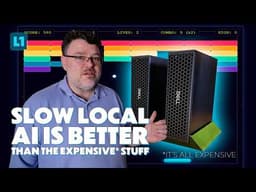
Running Frontier AI Models Locally: How Dual DGX Spark Systems Rival Expensive Cloud Computing
AI summary of “Running Frontier AI Models Locally: How Dual DGX Spark Systems Rival Expensive Cloud Computing” by Level1Techs, generated by Sumvid.
Title
Running Frontier AI Models Locally: How Dual DGX Spark Systems Rival Expensive Cloud Computing
One-Sentence Summary
A dual DGX Spark system running DeepSeek achieves comparable results to a quad RTX Pro 6000 setup (costing seven times more) while maintaining practical performance for real-world AI tasks, demonstrating that accessible local AI is finally becoming viable.
Key Takeaways
- [0:00] Small, affordable hardware clusters can now achieve comparable results to expensive enterprise AI systems, challenging the economic viability of costly cloud AI services charging $25 per million tokens.
- [1:35] The dual DGX Spark system (around $8,000-$10,000 total) produces largely identical outputs to a quad RTX Pro 6000 system ($70,000+) when running DeepSeek in 4-bit quantization, with the expensive system being only about seven times faster while costing seven times more.
- [2:39] Quantization techniques like NVFP4 preserve model quality remarkably well—the speaker found that only counting tasks showed significant degradation with quantized versions, while coding, logic, and other tasks performed identically to full-precision models.
- [6:46] AI should be viewed as human augmentation (like power tools) rather than human replacement; the speaker demonstrates this through practical applications like agentic task-splitting using harnesses like Turnstone, not simple chatbot interaction.
- [13:32] Real-world task performance matters more than token speed benchmarks—the dual Spark setup excels at practical work like code review, security auditing, debugging, and repository cleanup, proving its utility despite memory bandwidth limitations.
- [19:48] The trajectory toward Recursive Self-Improvement (RSI) is evident; AI models can now analyze requirements, break down complex tasks into subtasks, and iterate toward success criteria, similar to how personal computers revolutionized computing in the 1980s.
- [27:28] The entire AI ecosystem benefits from software improvements regardless of hardware; newer, smaller models now outperform larger models from six months ago, and the gap between cloud AI and local AI capabilities is shrinking from years to months.
- [32:40] While impressive, buyers should be cautious about purchasing local AI hardware immediately since the field is moving extremely fast; cloud services like Open Router offer cost-effective alternatives for learning, and this hardware is best suited for commercial or job-critical applications.