Infancy and Toddlerhood: Newborn Development, Growth, and Early Brain Development (Lecture)
AI summary of “Infancy and Toddlerhood: Newborn Development, Growth, and Early Brain Development (Lecture)” by Dr. Ingle's Education Videos, generated by Sumvid.
Title
Infancy and Toddlerhood: Newborn Development, Growth, and Early Brain Development (Lecture)
One-Sentence Summary
A child-development lecture that walks through newborn traits, prematurity, reflexes, physical growth, brain development, and motor skills, and argues that early interactive experiences shape lifelong development.
Worth Watching If
You're a student or early-childhood educator who wants an overview of the first years of life. It's a lecture-style introduction with anecdotes, so it's better for building a foundation than for in-depth or current clinical guidance, and some figures and claims need checking (see Caveats).
Chapters
- [0:00] Introduction to infancy and toddlerhood as the next stages in the course's sequence of child development
- [1:05] Newborn traits: typical birth weight and length, the soft spot on the head, umbilical cord timing, and feeding frequency
- [2:42] Premature and low-birth-weight babies: prevalence, causes, survival, and common health risks
- [4:47] The vaccination controversy, with reading and viewing recommendations
- [5:55] Infant reflexes and the Apgar test
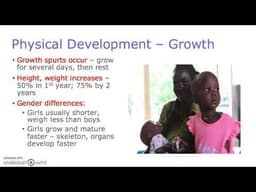
- [6:58] Physical growth patterns, growth spurts, and sex differences
- [8:34] Brain development: neuron growth, synapses, and brain size milestones
- [10:10] Experience-dependent plasticity: why babies need interactive stimulation, play, and "serve and return"
- [12:13] Nutrition: breastfeeding recommendations and when to introduce solids
- [13:47] Motor development: fine versus gross motor skills
Key Takeaways
- [1:05] Healthy newborns typically weigh 5.5 to 10 pounds and measure about 20 inches long. Every baby has a soft spot on the head, and the skull bones fuse over the first few months.
- [1:36] Newborns typically feed every 1.5 to 2 hours. Feeding becomes less frequent and sleep longer after roughly the first six to eight weeks.
- [2:42] Premature and low-birth-weight births occur in about 10% of births worldwide. Prematurity is a leading cause of newborn death, but many premature babies survive, including some born as early as 22 to 24 weeks with neonatal intensive care.
- [3:43] The main concerns with prematurity are birth defects, developmental problems, and respiratory, digestive, and immune issues. Asthma and learning disabilities are common in premature children, and the speaker says respiratory problems are the greatest worry.
- [5:55] Newborn reflexes such as rooting, sucking, swallowing, and blinking help infants survive. Most primitive reflexes fade within the first year, though sucking often persists as a comfort behavior, such as thumb-sucking.
- [7:29] Growth occurs in spurts. Infants typically increase their weight and height by about 50% in the first year and about 75% by age two, with girls generally shorter and lighter than boys but maturing faster.
- [9:06] At birth the brain is about 25% of adult weight; by age three it is about 75%. The brain has an estimated 100 to 200 billion neurons.
- [10:10] Without stimulation, infants lose synapses, which reduces their ability to form connections. Experience-dependent plasticity, such as playing, talking, and being read to, supports brain growth.
- [12:13] Serve-and-return interaction, like rolling a ball back and forth with an infant, is presented as a key way to build the brain.
- [12:45] Breastfeeding is recommended as the exclusive food for about four to six months, after which solids are introduced. Formula-fed or non-breastfed children can still grow up healthy.
- [13:47] Fine motor skills (grasping, reaching) and gross motor skills (head lifting, rolling, sitting, walking) develop in sequence and support physical and cognitive development.
Action Items
- Engage infants in back-and-forth interaction, such as rolling a ball, talking, and responding to their sounds and gestures.
- Provide sensory experiences like music, light, mobiles, and being read to.
- Give toddlers active play opportunities, such as kicking and throwing balls or banging pots and pans, rather than only watching.
- Offer safe small objects, such as a plastic set of keys, so infants can practice grasping and explore color and sound.
- Check current breastfeeding and solid-food guidance with a pediatrician, since the lecture's timing may be outdated.
Caveats
- Growth figures are likely wrong. The lecture says weight and height increase by 50% in the first year and 75% by age two. Typical infant birth weight roughly triples by about one year, so these numbers should be verified against a pediatric growth reference.
- Apgar description is inaccurate. The Apgar score assesses heart rate, breathing, muscle tone, reflex response, and skin color. The lecture's list of breathing, rooting, sucking, swallowing, and blinking does not match the standard test.
- Feeding timing may be outdated. Current guidance from major pediatric and public health bodies generally recommends exclusive breastfeeding for about six months, not four to six.
- Overstated claims. Saying a baby who isn't stimulated "loses intelligence" is a strong simplification of brain research.
- Dated or unsourced references. The claim that the Birth to Three program is "very well-funded" and the Massachusetts funding remark are presented without sources and may be out of date. The vaccine-autism study is described as "disproven" without naming it, though the broader scientific consensus supports the lecture's conclusion.
- Sponsorship: None noted.