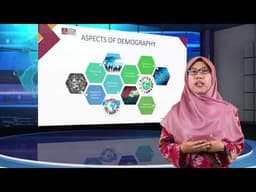
Demography Basics: Aspects and Challenges of Population (Part 3, Chapter 1)
AI summary of “Demography Basics: Aspects and Challenges of Population (Part 3, Chapter 1)” by UTMCDex, generated by Sumvid.
Title
Demography Basics: Aspects and Challenges of Population (Part 3, Chapter 1)
One-Sentence Summary
This lecture defines demography, outlines six aspects of population study, and describes the main challenges that population pressures create.
Worth Watching If
You are a student new to demography or population studies and want a quick overview of its core terms. It is a brief, introductory lecture with no examples, data, or sources, so it works best as a glossary-style review rather than deep analysis.
Chapters
- [0:00] Introduction: demography is defined by its etymology ("demos" for people, "graphein" for writing) and linked to population studies.
- [0:33] Achille Guillard's definition of demography, followed by the first four aspects: population size, growth or decline, population processes, and distribution.
- [1:35] The last two aspects: population structure (age and sex) and population characteristics (income, occupation, education, family).
- [2:07] Challenges of demography, starting with overpopulation and depopulation and their effects on fertility, mortality, environment, resources, poverty, education, health care, and political power.
- [2:38] Migration, food supply, and uneven population distribution as further challenges.
Key Takeaways
- [0:00] Demography comes from the Greek "demos" (people) and "graphein" (to write), so it means writing about people and populations.
- [0:33] Achille Guillard defined demography as the mathematical knowledge of populations, their general movement, and their physical, civil, intellectual, and moral state.
- [0:33] The lecture lists six aspects of demography: population size, growth or decline, population processes (fertility, mortality, migration trends), distribution, structure, and characteristics.
- [1:35] Population structure refers to the number of males and females in each age group.
- [1:35] Population characteristics include income, occupation, education, and family and household relationships.
- [2:07] Overpopulation and depopulation are presented as linked to fertility, mortality, environmental damage, access to resources, poverty, education, health care, and political power.
- [2:38] Migration is said to contribute to underdevelopment in rural areas, including unused land, overcrowding, and unemployment.
- [2:38] Uneven population distribution between rural and urban areas is said to cause economic imbalances across regions.
Caveats
- The lecture presents several causal claims as settled without evidence or nuance. For example, it says overpopulation "leads to" food shortage and migration "generally leads to" rural underdevelopment. These relationships depend heavily on context, such as agricultural technology, governance, and economic conditions.
- No sources, dates, data, or named studies are given beyond the single definition, so the claims cannot be checked from the video alone.
- The transcript appears to render the name as "achill glide," which likely refers to Achille Guillard, who coined the 1855 definition. Verify the attribution if you cite it.