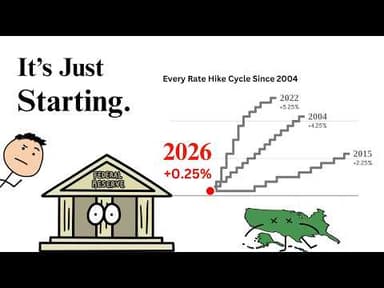
The AI Buildout Trap: Why Rising Interest Rates Threaten the Economy's Growth Engine
Casual Finance13:43Open on YouTube ↗
AI summary of “The AI Buildout Trap: Why Rising Interest Rates Threaten the Economy's Growth Engine” by Casual Finance, generated by Sumvid.
Title
The AI Buildout Trap: Why Rising Interest Rates Threaten the Economy's Growth Engine
One-Sentence Summary
The Federal Reserve's rate hikes pose an unprecedented threat to the $5 trillion AI infrastructure buildout that now drives U.S. economic growth, as companies must continuously refinance massive debt loads at increasingly expensive rates.
Key Takeaways
- [0:00] The Federal Reserve raised interest rates unanimously in September after a 9-3 split in July, signaling a shift in inflation outlook that forced officials to acknowledge monetary policy wasn't working.
- [1:31] Historical data shows rate-tightening cycles rarely stop after one hike; the Fed's projections indicate at least one more increase by year-end, with some economists forecasting three consecutive hikes.
- [2:03] Of 14 tightening cycles between 1955-2009, 10 were followed by recessions within 18 months, with only three achieving the "soft landing" outcome of raising rates without economic damage.
- [3:06] The Fed's traditional lever—the housing market—is now broken due to "rate lock," where 78% of mortgage holders are locked in below 6%, freezing home sales at 15-year lows and eliminating the primary transmission mechanism for rate hikes.
- [5:40] Tech companies funding the $5 trillion AI infrastructure buildout are issuing record bond volumes ($132 billion in 7 months of 2024), representing roughly half the entire investment-grade bond market and forcing continuous debt refinancing.
- [9:18] AI company debt is repricing in real time, with borrowing costs rising from 6-8% for established firms to 15-20% for venture-backed companies, while break-even analysis shows the market bottom is already underwater at current rates.
- [11:55] AI capex is growing at roughly twice the rate of the 2002-2005 housing boom and now represents 1.5 percentage points of GDP growth—making it the economy's primary growth driver while facing escalating refinancing costs.
Suggested Category Tags
Economics, Federal Reserve, AI Infrastructure, Debt Crisis, Interest Rates
More from Casual Finance
- The U.S. Debt Crisis and the Battle Over Treasury Yields: Growth vs. Market Reality
- The AI Bubble Explained: Why Supply Matters More Than Demand