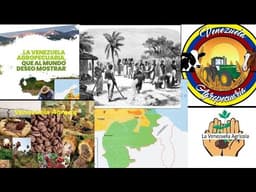
Agrarian Venezuela: Land, Power, and the Shift to Oil (1830–1920)
AI summary of “Agrarian Venezuela: Land, Power, and the Shift to Oil (1830–1920)” by JP13, generated by Sumvid.
Title
Agrarian Venezuela: Land, Power, and the Shift to Oil (1830–1920)
One-Sentence Summary
This short lecture explains how Venezuela's economy, land ownership, and social hierarchy were organized around agriculture between 1830 and 1920, and how that system gave way to dependence on oil exports.
Worth Watching If
You want a quick overview of Venezuela's pre-oil agrarian economy and its class structure. It is brief and general, with no sources or data, so use it as an introduction rather than a detailed history.
Chapters
- [0:00] Introduces the period (1830–1920) when Venezuela's economy and territory depended on agriculture and, to a lesser extent, livestock.
- [0:32] Describes the landowners (terratenientes), who held large estates and wielded political and economic power, versus the peasants who worked the land.
- [1:02] Explains how land holdings translated into power and how this produced economic inequality.
- [1:32] Covers the instability of agriculture and the neglect of rural areas in health, education, transport, and infrastructure.
- [2:04] Lists the main agricultural regions and their crops, starting with the Andean states of Mérida, Trujillo, and Táchira.
- [2:36] Continues the regional breakdown, covering the western plains, the east, and the crops grown in each.
- [3:07] Concludes with the shift from agriculture to petroleum exports, rising food imports, and the 1989 neoliberal opening.
Key Takeaways
- [0:00] Between 1830 and 1920, Venezuela's economy and territorial structure were based on agricultural and, secondarily, livestock production for domestic and export markets.
- [0:32] Landowners (terratenientes) held large estates and dominated political and economic life, while peasants who worked the land occupied the bottom of the social hierarchy.
- [1:02] Control of land determined power, and the resulting inequality shaped both the economy and rural social life.
- [1:32] Cities received priority, leaving rural areas without adequate health, education, transport, and infrastructure.
- [1:32] Agricultural income was unstable because export prices could fall suddenly, and losses in the countryside affected the broader economy.
- [2:04] The Andean states of Mérida, Trujillo, and Táchira specialized in tubers and vegetables.
- [2:36] The western plains states (Portuguesa, Barinas, Apure, Cojedes) produced grains, cereals, cotton, and sugarcane. The eastern and central regions grew sugarcane, cacao, and coffee.
- [3:07] The economy shifted from agriculture to oil exports after oil was discovered. The narrator dates the change to around 1920.
- [3:07] Food import dependence intensified after the 1989 neoliberal opening and later food-security policies.
Caveats
- The transcript contains apparent transcription or spelling errors, such as "Surre" (likely Sucre), "Anzuágui" (likely Anzoátegui), and "danos" (likely maíz or granos). Verify the regional list against a reliable source.
- The claims are presented without citations, data, or historians' sources, and the narrator's conclusions are simplified.
- The 1920 date for the shift to oil is approximate. Commercial oil production began in the late 1910s and the oil boom took hold in the early 1920s, so treat the date as a rough marker.
- The closing references to the 1989 liberalization and later food policy are asserted briefly and without analysis.