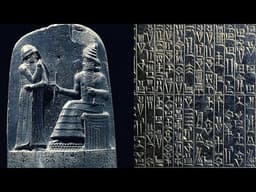
The Code of Hammurabi: Babylon's Ancient Law Code and Its Society
AI summary of “The Code of Hammurabi: Babylon's Ancient Law Code and Its Society” by Astraway, generated by Sumvid.
Title
The Code of Hammurabi: Babylon's Ancient Law Code and Its Society
One-Sentence Summary
This video explains the Code of Hammurabi, a set of around 282 laws carved onto a diorite stele in Babylon around 1750 BCE, and places it within Babylon's rise, Hammurabi's reign, and the social order the laws reflected.
Worth Watching If
You want an accessible introduction to Mesopotamian history and the Code of Hammurabi, including its structure, social classes, and sample penalties. It is mostly encyclopedic background, so it offers little new to readers who already know the subject well.
Chapters
- [0:00] Introduces the Code of Hammurabi, its date, and the diorite stele it was written on
- [0:31] Describes Babylon's rise and Hammurabi's campaigns of conquest and legal unification
- [1:05] Explains the basis of the laws in lex talionis (eye for an eye) and the burden of proof
- [1:38] Covers the geography of Mesopotamia and the origins of cities, writing, and city-states
- [2:11] Surveys the Sumerian and Akkadian civilizations and their unification of city-states
- [3:19] Describes the Amorite takeover, the period of anarchy, and the founding of the Babylonian dynasty
- [3:55] Profiles Hammurabi's life, reign, and religious and administrative policies
- [5:38] Discusses the purpose of the Code and the religious legitimacy it claimed
- [6:43] Describes the physical stele, its dimensions, its relief carving, and its column layout
- [7:48] Covers the language, the prologue and epilogue, and the elevation of Marduk
- [8:19] Explains the three-part structure and the principle of proportional punishment
- [9:24] Covers wages, professional liability, court procedures, and the crimes listed
- [11:02] Explains the three social classes: awilum, mushkenum, and wardum
- [12:05] Gives examples of penal laws and the relative equality before the law
- [13:16] Discusses debt, family law, and the legal status of women
Key Takeaways
- [0:00] The Code consists of 282 laws inscribed on a black diorite stele about 2.25 meters tall, dated to around 1750 BCE.
- [0:31] Hammurabi, the sixth king of the first Babylonian dynasty, reigned for about 60 years and used conquest and legal unification to consolidate power across Mesopotamia.
- [1:05] Penal law was largely based on lex talionis, with punishment matching the harm caused, and the victim was expected to prove the offense.
- [5:38] The Code was presented as divinely sanctioned: Hammurabi is shown receiving the laws from Shamash, the sun and justice god, in a relief at the top of the stele.
- [6:43] The stele's laws are arranged in 24 columns on the front and 28 on the back, and the original stood in the temple of Shamash at Sippar before being moved to Susa in 1158 BCE.
- [8:19] The Code has three parts: a first-person prologue listing Hammurabi's achievements, the legal body, and an epilogue.
- [9:24] Professional liability was strict: if a house collapsed and killed its occupants, the builder (architect) could be executed.
- [11:02] Society was divided into three classes: the awilum (free men, the wealthiest), the mushkenum (dependents of the state, semi-free), and the wardum (slaves, treated as property).
- [12:05] Courts were meant to replace private revenge, and penalties were differentiated by status; a slave had no legal protection.
- [13:46] Family law included 60 provisions and asserted male superiority, but some articles show consideration for women, such as requiring a contract for a marriage to be legal.
Caveats
- The video calls the Code the oldest legal corpus ever found, which is overstated. Earlier law collections, such as the Code of Ur-Nammu, predate it.
- Dates are inconsistent: the video gives Hammurabi's reign as 1722–1686 BCE and then 1792–1750 BCE "according to the middle chronology," without fully reconciling them. It also says his birth year (about 1810 BCE) is uncertain.
- The claim that the Code introduced a presumption of innocence is an interpretation and is presented too confidently.
- Some examples, such as brewers being drowned in their own beer, are presented as typical without context. Historians debate how literally many of the provisions were applied.
- The presentation of the Sumerians as the first civilization and the Code as "the first" legal system is simplified.
- The description of the Code as a lasting step toward equality is a value judgment. The video notes the hierarchy, but its framing leans toward praise.