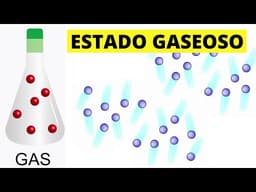
The Gaseous State of Matter: Properties and Examples
AI summary of “The Gaseous State of Matter: Properties and Examples” by Astraway, generated by Sumvid.
Title
The Gaseous State of Matter: Properties and Examples
One-Sentence Summary
This video explains what defines the gaseous state of matter, including weak particle interactions, no fixed shape or volume, poor heat and electricity conduction, and reactivity, and gives examples of gaseous elements and compounds.
Worth Watching If
You are new to states of matter or need a quick, structured reference on gases. It covers textbook basics without depth, so it is not useful for anyone who already knows this material.
Chapters
- [0:00] Defines the gaseous state and contrasts gases' freedom of movement with the chaos of their particles.
- [0:31] Gives everyday examples of gases, such as the atmosphere, greenhouse gases, and exhaled carbon dioxide.
- [1:03] Shows how smoke demonstrates gases dispersing, and compares particle behavior across gas, liquid, and solid.
- [1:36] Explains that interactions between gas particles are negligible, unlike the strong cohesion in liquids and solids.
- [2:07] Describes large gaps between gas particles and how each particle moves freely until it collides with another particle or a container wall.
- [2:37] Covers the lack of fixed shape or volume, so a gas takes the shape of its container, and notes helium can escape Earth's atmosphere.
- [3:09] Lists properties: poor conduction of heat and electricity, lower density, and colorlessness for many gases, so quantity can be measured by pressure.
- [3:39] Discusses reactivity (except noble gases) and the hazards of fire and respiratory entry, and describes small gas particles.
- [4:14] Lists gaseous elements from the periodic table, notes that metals can become gases above their boiling points, and lists gaseous compounds such as CO, CO₂, and NH₃.
- [5:52] Concludes the compound list with examples including iodine vapor, sulfur hexafluoride, and hydrogen chloride.
Key Takeaways
- [0:00] Gas particles are held together only by weak interactions and move freely throughout their container.
- [0:31] Common gases include water vapor, carbon dioxide, methane, and ozone, and the air we breathe is a gas mixture.
- [1:36] Intermolecular interactions in gases are described as negligible, which is the main difference from liquids and solids.
- [2:37] Gases have no defined shape or volume; they take the shape of their container and spread out unless contained.
- [3:09] Gases are poor conductors of heat and electricity and are generally less dense than liquids and solids.
- [3:09] Because most gases are colorless, the amount of gas in a container can be determined by measuring its pressure.
- [3:39] Gases tend to be more reactive than liquids or solids (noble gases excepted), creating fire and inhalation hazards.
- [4:14] Gaseous elements at Earth conditions include hydrogen, helium, nitrogen, oxygen, fluorine, chlorine, neon, argon, krypton, and xenon.
- [4:47] Any metal can become a gas if heated above its boiling point, such as iron, mercury, or gold.
- [5:20] Notable gaseous compounds include ammonia (NH₃), methane (CH₄), nitrogen dioxide (NO₂, brown), and phosgene (COCl₂, highly toxic).
Caveats
- The claim that gases are "more reactive than liquids or solids" is an overgeneralization. Reactivity depends on the specific substance, not the state alone.
- Describing gases as having negligible interactions is a simplification. Real gases show weak attractions, most noticeably near condensation.
- The statement that helium escapes Earth is a loose simplification of atmospheric escape, which depends on temperature and gravity.
- The video does not mention pressure, temperature, or gas laws, which are central to understanding gases.