The Nature of Light: Physics, Perception, and Practical Applications
Pablo Costamagna UNLa EMMALZ1:37:17Open on YouTube ↗
AI summary of “The Nature of Light: Physics, Perception, and Practical Applications” by Pablo Costamagna UNLa EMMALZ, generated by Sumvid.
The Nature of Light: Physics, Perception, and Practical Applications
One-Sentence Summary
This comprehensive lecture explains the fundamental physics of light, how it behaves as both a wave and particle, how the human eye perceives it, and how this knowledge applies to cameras, lighting, filters, and color correction in cinematography.
Key Takeaways
- [0:01] Light can be understood as the acceleration of electrons around atomic nuclei, which generates electromagnetic fields traveling at the speed of light (300,000 km/s), and this understanding is essential for working with luminaires, camera sensors, and filters without relying on trial-and-error
- [1:03] Historically, light was proven first to behave as a wave rather than matter, so most modern devices are built using wave characteristics, though quantum physics later confirmed light also has particle properties (photons), meaning current technology standards may evolve
- [3:41] The electromagnetic spectrum is divided by wavelength measured in nanometers, with human eyes capable of seeing only between approximately 750 nm (red) and 400 nm (violet), while infrared and ultraviolet wavelengths remain invisible but can still cause damage to matter through ionizing radiation
- [11:35] Light waves have two critical characteristics: amplitude (which determines intensity and brightness) and wavelength (which determines color), and these can be measured and adjusted independently—a concept essential for using tools like the vector scope and color correction software
- [26:21] The visible light spectrum follows a consistent color order (red, orange, yellow, green, blue, indigo, violet) remembered through either "vamos a ver a Ramón" or the acronym "ROYGBIV," and this order appears consistently in color-correction software and professional tools
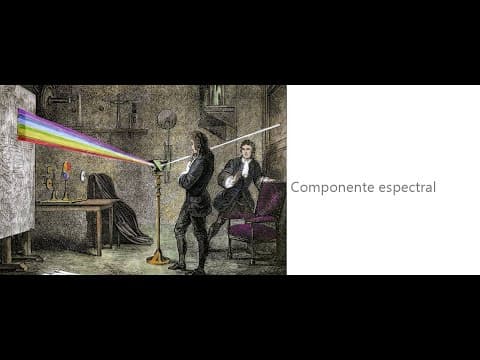
- [42:11] White light is composed of the complete sum of all colors, as demonstrated by Isaac Newton's prism experiment, meaning that understanding additive color mixing (RGB) allows for precise color correction and camera matching using vector scopes and color grading tools
- [53:09] Objects are not seen directly but through reflected light; surfaces with different molecular compositions reflect different wavelengths, and understanding reflection indices, absorption rates, and how materials interact with specific colors is critical for lighting decisions and color-accurate cinematography
- [1:33:55] The human eye contains two types of light-sensitive cells—cones (which sense color in normal lighting conditions) and rods (which sense luminosity/brightness)—and in low-light situations, rods attempt to sense both, resulting in altered color perception known as scotopic or Purkinje vision, which filmmakers often recreate with bluish tones
Suggested Category Tags
More from Pablo Costamagna UNLa EMMALZ
All Pablo Costamagna UNLa EMMALZ summaries