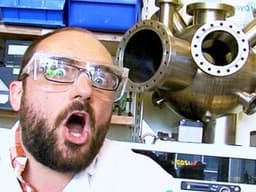
The Rarest Element for an Engagement Ring: A Journey Through the Periodic Table
AI summary of “The Rarest Element for an Engagement Ring: A Journey Through the Periodic Table” by Vsauce, generated by Sumvid.
Title
The Rarest Element for an Engagement Ring: A Journey Through the Periodic Table
One-Sentence Summary
Michael explores what the rarest, most stable element on Earth would be to make an engagement ring from, conducting experiments with various metals before concluding that platinum-190 is the answer.
Key Takeaways
- [0:01] Michael poses the question of what the rarest, scarce, stable, and safe element would be to craft an engagement ring from, moving beyond typical choices like gold, silver, and platinum
- [0:33] Through experiments at the University of Nottingham, Michael demonstrates chemical reactions with various elements including vanadium in mercury and zinc, which change colors as electrons are transferred
- [1:40] Although vanadium is interesting, it isn't rare enough; the search continues for something more precious and scarce
- [2:46] Astatine is introduced as an extremely rare element so radioactive that it would vaporize instantly if enough atoms were gathered to be visible to the naked eye, making it unsuitable for a ring
- [3:49] Gold, despite being valuable and non-reactive, can be dissolved in aqua regia (a mixture of hydrochloric and nitric acid), and even though particle accelerators can create gold atoms, it would take 50 million years to produce just 1 gram
- [5:28] Iridium and osmium, members of the platinum family, are far rarer than gold, with osmium having fewer than one part per billion in Earth's crust
- [6:37] Platinum-190, a stable isotope of platinum with a half-life over a billion years, is identified as the answer—the scarcest naturally occurring stable, non-reactive element suitable for an engagement ring
Suggested Category Tags
More from Vsauce

The Science and Sociology of Swear Words: Why Some Words Are "Bad"
Vsauce
The Banach-Tarski Paradox: How to Turn One Sphere Into Two
Vsauce

What Makes Things Creepy? The Science of the Uncanny
Vsauce
What is Randomness? From Coin Flips to Quantum Mechanics
Vsauce
Understanding Awkwardness: Why Social Discomfort Matters and How Perspective Helps
Vsauce

What Makes You "You"? Exploring Consciousness and Personal Identity
Vsauce