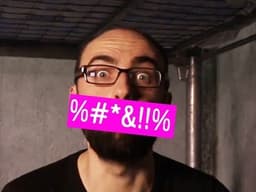
The Science and Sociology of Swear Words: Why Some Words Are "Bad"
AI summary of “The Science and Sociology of Swear Words: Why Some Words Are "Bad"” by Vsauce, generated by Sumvid.
Title
The Science and Sociology of Swear Words: Why Some Words Are "Bad"
One-Sentence Summary
Michael from Vsauce explores the linguistic, historical, and neurological reasons why certain words are considered taboo, and how the definition of "bad words" evolves over time based on societal fears and values.
Key Takeaways
- [0:00] Over 600,000 recorded phone conversations revealed that Ohio residents use curse words most frequently while Washington state residents use them least, demonstrating regional variation in swearing habits.
- [1:09] Swear words comprise only about 0.7% of the average English speaker's daily vocabulary—nearly the same frequency as first-person plural pronouns—making them proportionally as important to our speech as common grammatical elements.
- [2:11] Steven Pinker identifies five distinct types of swearing: abusive swearing (intended to hurt), supernatural swearing (religious blasphemy), emphatic swearing (to convey emotional intensity), idiomatic swearing (casual atmosphere-setting), and cathartic swearing (pain relief through the medical phenomenon of "lalochezia").
- [5:22] Many English swear words reflect historical class divisions—Germanic words from lower-class Saxons became taboo while Latinate/French words from upper-class Normans remained acceptable (e.g., "defecate" vs. "s***").
- [6:57] Swearing activates different brain regions than regular language and involves the limbic system, which explains why people with aphasia can swear fluently despite language impairment, and why swearing provides genuine physiological pain relief.
- [8:02] As society's fears evolve, so do taboo words: as disease and sexuality become less frightening, words related to them lose their taboo status, while words related to mental health conditions and class disadvantage are increasingly becoming the new profanities.
- [9:35] Bad words function as important social boundaries that constantly shift—they represent society's reaction to injustice and are essential for expressing dissent and pushing for social change.
Suggested Category Tags
More from Vsauce

The Banach-Tarski Paradox: How to Turn One Sphere Into Two
Vsauce
What Makes Things Creepy? The Science of the Uncanny
Vsauce
What is Randomness? From Coin Flips to Quantum Mechanics
Vsauce
Understanding Awkwardness: Why Social Discomfort Matters and How Perspective Helps
Vsauce

What Makes You "You"? Exploring Consciousness and Personal Identity
Vsauce
The Rarest Element for an Engagement Ring: A Journey Through the Periodic Table
Vsauce